Fresh ideas from museums around the globe in your inbox each week

October 23 2026
 By Manuel Charr
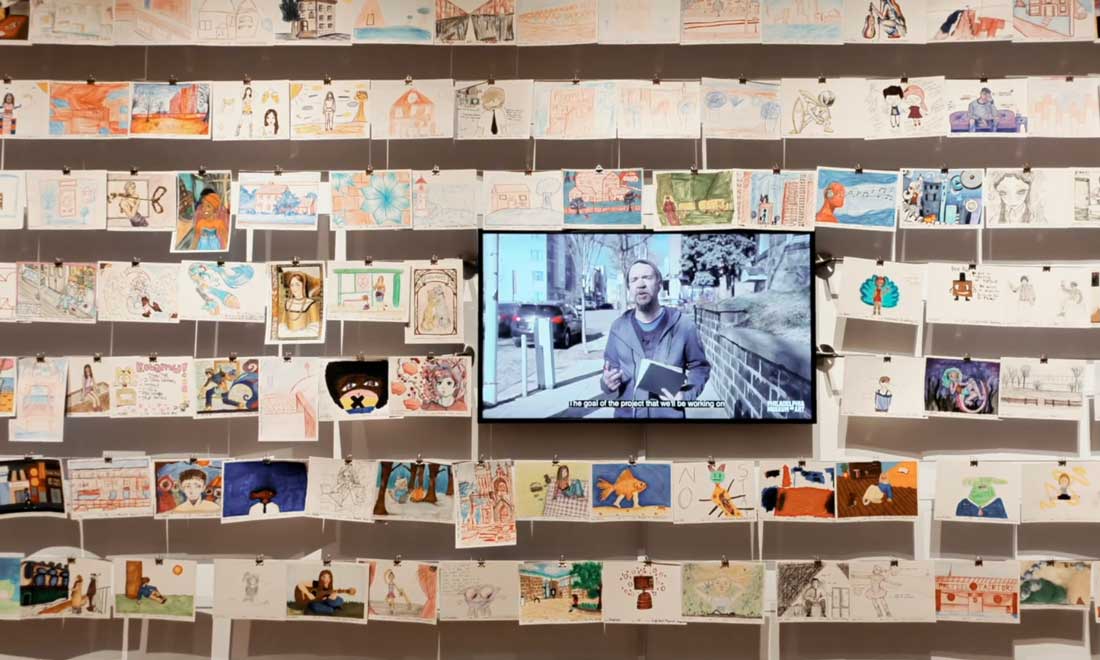
How do you make a major gallery reinstallation feel relevant to young people who may never have visited your museum? The Philadelphia Museum of Art answered that question with a simple tool: a postcard. Its teen programs team distributed more than 2,000 blank postcards to local teens and collected over 600 drawings back for display in the museum.
The drawings were prompted by two short instructional videos, each led by a Philadelphia teaching artist and rooted in themes from the museum’s reinstalled American art galleries. The result was a teen community engagement project that combined real curatorial depth with wide community reach, and brought new families through the museum’s doors.
The challenge: connecting a gallery reinstallation with local teens
The museum reinstalled its American art galleries to mark the semiquincentennial, the 250th anniversary of the United States. The new presentation, A Nation of Artists, asks a pointed question: who gets to be an American artist?
The teen programs team attended curatorial presentations ahead of the reinstallation. Their goal was to build a bridge between the themes on the gallery walls and the lives and interests of Philadelphia teenagers. Rather than simply explaining the curators’ question, they decided to turn it into an invitation.
The model: postcards and teaching-artist videos
The format was deliberately low-barrier. Teens received a postcard-sized card and watched one of two videos, each featuring a local teaching artist leading a drawing lesson. Each lesson grew out of the artist’s own practice while also reflecting a strand of American art history represented in the galleries.
This structure did two jobs at once. It gave teens a creative entry point that needed no prior museum knowledge. It also gave schools a ready-made activity tied to a real exhibition. For another approach to classroom-ready resources, see how Tate Schools designs digital art resources with teachers.
Lesson one: landscape and cityscape with Andrew Chrisman
The curators were asking what our relationship with the American landscape looks like 250 years on. That led the team to Andrew Chrisman, a native Philadelphian artist and educator known for place-based workshops that explore how people interact with their surroundings.
In his video, Chrisman invites teens to document a place that matters to them, looking out of a window or along their own block. The method is simple and memorable:
- Breathe and reset to arrive in the present moment and look at familiar places with fresh intention.
- Scan the scene for something visually interesting or emotionally moving.
- Observe and draw, using blue for natural elements and red for the built, human-made environment.
- Look again and repeat, perhaps changing the medium or focusing on pattern and texture.
Chrisman demonstrated by drawing a vacant lot outside his studio, with pavement in red and vines climbing the fence in blue. He framed the activity as part of a 250-year tradition of American artists drawing landscapes and cityscapes.
What came back
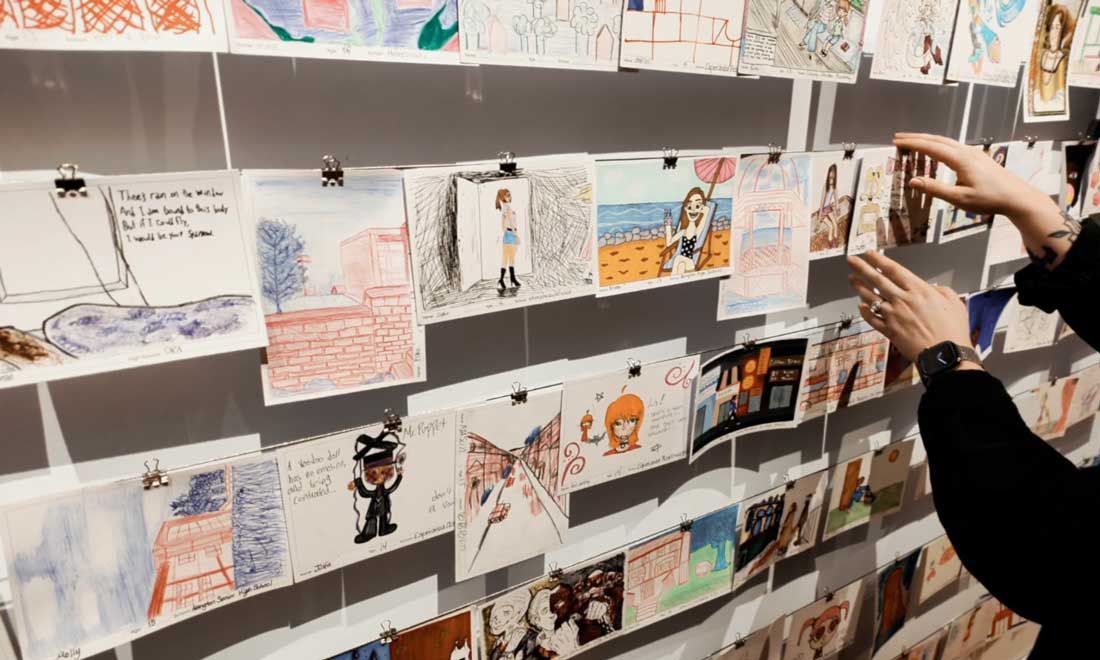
The responses added up to a sweeping portrait of Philadelphia. The activity worked across skill levels: some teens produced accomplished realistic landscapes, while for others it was a first attempt.
The two-colour approach also revealed something about the city itself. Some teens sought out places full of nature. Others showed that their immediate walking radius held few natural elements, or none at all. Seen together on the wall, the drawings taught the museum team about everyday life across the city, from school buildings to family trips.
Lesson two: narrative and character design with Cindy Luzito
The narrative paintings in A Nation of Artists, including work by Horace Pippin, Beauford Delaney and Florine Stettheimer, pointed the team towards Philadelphia illustrator and muralist Cindy Luzito. Students had also been asking repeatedly for help with character design.
Luzito’s video starts with observation. She sketches the people around her on public transport, then returns to the studio to build a single character from those notes. Along the way she models a healthy creative process:
- Treat the sketchbook as a safe space and start with basic shapes and gesture.
- Add clothing and accessories to make the character feel like a real person, or push towards fantasy.
- Work in pencil first, then commit with pen and marker.
- Test a limited colour palette of light, dark and mid-tone before applying it.
- Annotate the character with words describing their personality, then sign the work.
Throughout, she reassures viewers that nervousness, doubt and mistakes are a normal part of making art. She closes by telling teens that narrative storytelling has been part of American art for more than 200 years, and that their character now belongs to that tradition.
What came back
The responses ranged widely. Some teens turned sweet moments from daily life into cartoons, and museum staff recognised scenes from their own commutes. Others created poetic characters in imagined worlds, drawing on fantasy, anime, horror and sci-fi.
Many teens appeared to be exploring identity, giving their characters traits they found empowering or celebrating aspects of themselves and their friends. Luzito’s message about embracing mistakes clearly landed: polished finished drawings arrived alongside just as many sketches and first attempts.
Outcomes for students, teachers and the museum
The project delivered tangible benefits for every group involved.
- Students gained drawing skills and a public exhibition credit. Many saw it as a valuable line on a CV or college application.
- Teachers welcomed a museum-designed classroom activity linked to a live exhibition. Because the materials were ready to use, it was especially helpful at the busy end of the school year.
- The museum hosted an opening event for the teen exhibition, A Future of Artists. It attracted teens the team had not reached before, along with friends and family, some visiting the museum for the first time.
At the opening, teens could show off their own postcard, then walk into the galleries to see the works that inspired it. Because their drawings hung in the museum too, they experienced A Nation of Artists as participants in its conversation rather than as outside observers.
Lessons for museum professionals
For teams planning youth engagement or community programmes around an exhibition, this project offers a replicable model:
- Start with curatorial questions. Turning an exhibition’s central question into an open invitation gives participation real intellectual weight.
- Keep the format small and accessible. A postcard is cheap to distribute, quick to complete and easy to display in large numbers.
- Partner with local teaching artists. Artists whose practice already connects to the collection bring authenticity and a familiar local voice.
- Use video to scale instruction. Recorded lessons let thousands of teens take part without a facilitator in every room.
- Design for every skill level. Explicitly welcoming sketches and mistakes broadens who feels able to contribute.
- Display the results and celebrate them. An opening event turns contributors into visitors and brings their families with them.
As the presenters concluded, the postcard became a bridge that brought more of the community into the museum. Placing local teens in direct dialogue with curatorial themes extended the lineage of American art and added a contemporary Philadelphia voice to the question of who gets to be an American artist.
This article is based on a presentation given at the Creative Museums Summit on 21 October 2026 by Adrienne Justice, Associate Director of Teen Programs at the Philadelphia Museum of Art, and Caro Thomas, Coordinator of Teen Programs at the Philadelphia Museum of Art.


About the author – Manuel Charr
Manuel Charr is a journalist working in the arts and cultural sectors. With a background in marketing, Manuel is drawn to arts organizations which are prepared to try inventive ways to reach new audiences.


