Fresh ideas from museums around the globe in your inbox each week

Virtual reality (VR) is revolutionising the way museums connect with their audiences, creating immersive environments that enhance learning and engagement. In a recent conference session at MuseumNext, professionals involved with three pioneering efforts to integrate VR into museums shared their experiences.
Intrepid: managing timed visits and spectators
Elaine Charnov from the Intrepid Sea, Air & Space Museum in New York shared insights into their innovative approach to using VR. Situated aboard a historic aircraft carrier, the museum offers an impressive collection of artefacts, including 26 aircraft and the Space Shuttle Orbiter Enterprise. Despite its rich history, the museum faces challenges in displaying sensitive artefacts due to its non-climate-controlled environment. To address this, the museum turned to VR as a means of storytelling and engagement.

The museum developed a VR experience focused on the International Space Station (ISS), exploring life and work in microgravity. Using consumer-grade Oculus technology, the project aimed to deliver an inclusive, low-cost solution for visitors. The installation featured a capsule accommodating four participants at a time, with 10-minute intervals to manage high demand. During peak seasons, the experience attracted hundreds of visitors daily, underscoring its popularity.
“We wanted to create something that would be engaging, inclusive, and manageable within our existing resources,” Charnov explained. Accessibility was a core consideration. Laminated instructional cards in multiple languages, including French, Spanish, and Chinese, were provided for non-English speakers. To enhance the group experience, repeat screens allowed visitors to observe their friends or family members’ journeys. Additionally, the VR capsules were designed to accommodate wheelchair users. The success of this project has encouraged the museum to continue exploring innovative storytelling strategies through VR.
USHMM: building a story around the Ringelblum archive
Silvina Fernandez-Duque from the US Holocaust Memorial Museum in Washington, DC, discussed their efforts to harness the immersive power of VR to deepen engagement with Holocaust history. Their prototype focused on a single object—a milk can used to conceal and preserve documents in the Warsaw Ghetto as part of Emanuel Ringelblum’s clandestine efforts to document Jewish life under Nazi occupation.

“We wanted to create a respectful and meaningful way to connect visitors with this powerful story of resistance,” Fernandez-Duque shared. The team collaborated with a production company to create three virtual spaces, including Ringelblum’s office and a courtyard depicting the aftermath of a deportation. Visitors could interact with historical documents, hearing translations of their contents. The courtyard scene, with its linear narrative and emotional weight, proved particularly memorable, blending storytelling with spatial audio and visual elements.
Feedback from the prototype revealed that 97% of visitors felt the VR experience enhanced their learning. However, the project also highlighted the importance of transparency in representing historical spaces. Moving forward, the museum is exploring ways to adapt such experiences for remote audiences, ensuring accessibility beyond the physical museum.
Pollock-Krasner: reconstructing the artists’ studio
Robin White Owen from Media Combo presented on their collaboration with the Pollock-Krasner House and Study Centre in East Hampton, New York, which has used VR to bring iconic artworks back to their place of creation. The studio, once the workspace of Jackson Pollock and Lee Krasner, was meticulously recreated using photogrammetry and historical photographs. Visitors wearing VR headsets could explore the studio as it appeared in the late 1940s and 1950s, complete with the artists’ tools and paintings.
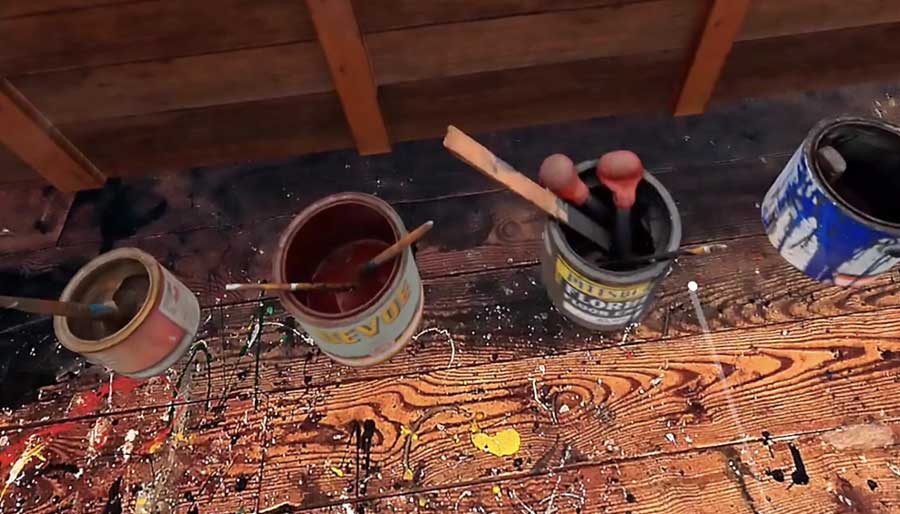
“The goal was to bring visitors closer to the artists’ world and to the process of creation,” White Owen noted. The experience combined self-directed exploration with guided narratives. Spatial audio and visual cues ensured visitors navigated the space intuitively, while captions and accessibility features catered to diverse audiences. The project, originally intended as a site-specific installation, was later made available on the Oculus Quest store, significantly expanding its reach.
Matching the visitor journey to the story
In a MuseumNext session, Elaine Charnov, Silvina Fernandez-Duque and Robin White Owen described three different approaches to museum VR. At Intrepid, the challenge included helping visitors enter the experience and letting companions follow along. At the US Holocaust Memorial Museum, a concealed archive provided the starting point for an encounter with historical documents; Fernandez-Duque reported that 97% of prototype participants felt it supported their learning. At Pollock-Krasner House, reconstruction connected artworks with the studio where they were made. Together, the projects offer useful examples of matching the visitor journey to the story.
Compare the scale of Kew’s one-day VR prototype with the decisions involved in managing group visits at 1238.
–
Robin White Owen, Silvina Fernandez-Duque and Elaine Charnov shared their work at MuseumNext in June 2022. To discover more work happening with virtual reality and museums, visit our blog.






