Fresh ideas from museums around the globe in your inbox each week

October 01 2025
 By Manuel Charr

Walk through the gates of Beamish Museum and you’re stepping into the past. From the grit of the 1820s to the optimism of the 1950s, the 350-acre site in County Durham is less a museum and more a time machine. Visitors ride vintage trams, smell bread baking in coal-fired ovens, and chat with costumed staff who seem to have walked straight out of another era.
But while the museum excels at recreating the past, it has been wrestling with a very modern problem: too many donations.
In 2024, Beamish completed the most ambitious capital project in its history, adding a new 1950s town and expanding its Georgian landscape. To support the development, the museum launched the Great Donate campaign, which brought in an astonishing 60,000 objects from the public—an unexpected windfall that quickly created new challenges for the collections team.
In his Digital Collections Summit 2025 presentation, Dan Hudachek described 50–70 unsolicited donation offers each week, despite no active call for donations in nearly a decade. That volume created a substantial administrative task.

Starting digital transformation with the problem helps explain why Beamish focused on a repetitive workflow rather than a new visitor-facing product.
When Paper Slows You Down
Managing incoming donations the traditional way—paper forms, manual entry, and scattered communication—quickly became unsustainable. Staff were drowning in administration. “This led to huge amounts of paperwork and data entry, which was accruing far quicker than staff could deal with,” they admitted. “So we needed a way to speed up the process.”
Like many institutions, Beamish had dreamt of digital forms. But a pilot project with off-the-shelf tools barely made a dent. “It would only save a few seconds off each donation,” the team realised. “We needed a more radical solution.”
The Radical Solution Was Hiding in Plain Sight
Enter Dan Hudachek, a member of the collections team with a knack for problem-solving. “That’s when we realised the solution had been there all along,” he said. “Microsoft 365.”
Using Power Apps, Power Automate, SharePoint, and Outlook—the same tools sitting quietly on desktops across the sector—Beamish built not one, but two apps to transform the donations process.
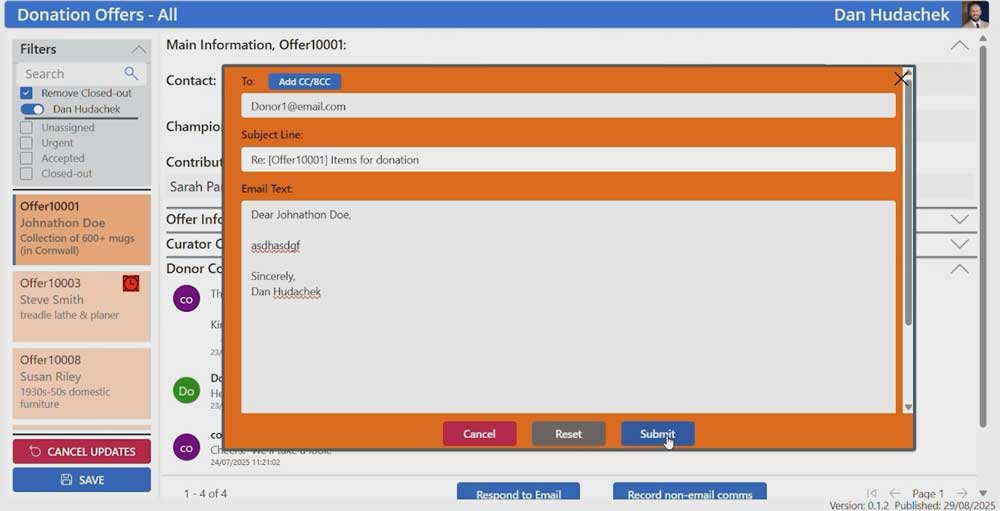
The offer-triage app tackled donation offers—the constant stream of emails from well-meaning donors. “All donation offers are channelled through a central inbox,” Hudachek said. “When a new offer arrives, the details are pulled from that email and put into the database.”
Curators can assign, comment, and even message each other directly within the app, ensuring decisions are documented. “It tracks the conversation, so we actually have a much better recording of why we’ve made a decision,” Hudachek noted. Better still, communication with donors happens inside the system too, with templated responses sent via Outlook for speed and consistency.
The object-entry app digitised the entry form used when an object arrived. “When a user logs in, they simply click, ‘Start a new entry,’ and it will jump them into the form,” Hudachek explained. The app dynamically adjusts based on the type of acquisition—loan, donation, or otherwise—and integrates photos, donor documents, permission fields and signatures. “The receipt is emailed directly to the donor, and all the data is ready to import into our collections management system. No retyping required.”
These permissions and signatures form part of Beamish’s documented process. Collecting them in an app does not by itself establish data-protection compliance or a valid transfer of title; each museum needs to agree the required records and procedures.
From Bottleneck to Breakthrough
The value of the system lies in connecting the workflows. “When that object arrives at the museum, we don’t need to rewrite or retype all of this information,” Hudachek said. “The donation offers app ports everything into the object entry app. It just cuts down so much on our data entry.”
Behind the scenes, Power Automate runs flows that carry out existing processes—renaming files, generating PDFs, sending receipts, and formatting CSVs for import. “Really, a lot of this is just taking your documentation procedural manual,” Hudachek reflected, “and rather than a human following the steps, Microsoft is following the steps.”
Licensing, ownership and maintenance
Before copying this approach, map your own object-entry procedure and agree the required records with your collections team. Check which Power Apps and Power Automate capabilities your Microsoft 365 licences include, especially any premium connectors. Assign an owner for the apps and flows, test exports into the collections system, and plan what staff will do if a flow fails. Microsoft’s licensing FAQ distinguishes included rights from premium capabilities; a Microsoft 365 subscription does not cover every connector or feature.
Collections recovery after a cyberattack is a reminder to include backups and continuity in plans for operational systems.
What Museums Can Learn
Beamish began with a pressing collections problem and connected the tools it used around that workflow. “By taking our individual challenges and applying these simple Microsoft tools, we’ve been able to build a programme that streamlines massively our documentation process,” Hudachek concluded.
The reported gain is reduced repeated data entry and better documentation of decisions. Hudachek’s account does not quantify hours saved or establish how staff subsequently used that time.
As Hudachek put it with a grin, “It just cuts down so much on our data entry.”
–
This article is based on Dan Hudachek’s presentation, “No More Paper Object Entry Forms”, at the Digital Collections Summit 2025 organised by MuseumNext. Dan is from Beamish Museum.


About the author – Manuel Charr
Manuel Charr is a journalist working in the arts and cultural sectors. With a background in marketing, Manuel is drawn to arts organizations which are prepared to try inventive ways to reach new audiences.