Fresh ideas from museums around the globe in your inbox each week

February 13 2023
 By Charlotte Coates

Museums can work with people who have moved across borders in many different circumstances. The examples here include refugees, artists and community members contributing knowledge, stories and professional skills. Their experiences should be described on their own terms, without assuming that every migration story is a refugee story.
How can museums work with refugees and migrants?
Museums around the world are working with migrants and refugees in different ways. Some museums have worked to give refugees a voice, highlighting their personal stories. This can help people to identify with the human side of the crisis. It also helps to counteract the stigma that is sometimes associated with being an immigrant.
Other institutions have collaborated with refugees to gain insight from their experiences. Refugees have worked as museum guides or helped visitors to connect with collections.

There are also museums dedicated to exploring the migrant experience throughout history. These explain some of the complex issues involved and lend a historical perspective. Other galleries and exhibitions showcase artistic works created by refugees and migrants.
Highlighting the human stories behind the headlines
The US Holocaust Memorial Museum opened a ‘portal’ in 2016. This allowed visitors to speak face-to-face with refugees. The exhibit ran for three months and during this time over 1,600 museum-goers interacted with it. Over a life-size screen, visitors spoke with different refugees. The participants were Iraqi refugees in Iran or Syrian refugees in Jordan or Germany.
The refugee crisis is a complex issue. It can be difficult for people in the Western world to comprehend what life is like in this situation. The refugees who participated in the portal project had to flee for their lives. They escaped the atrocities of the Islamic State, or the regime of Syrian President Bashar al-Assad. Many of the people who took part in the project will have experienced terrible things. Talking from the safety of the refugee camps, they were able to chat about their lives. They enjoyed talking about their hopes and dreams, and their plans for the future. The project gave people a human perspective on the issue.
“When we talk about genocides going on in the world, there’s a sort of numbing effect because the numbers are so big,” said Cameron Hudson who is the director of the museum’s Simon-Skjodt Centre for the Prevention of Genocide. “Through the portal experience, we’re able to go beyond the analysis and also tell the personal stories.”
The UK charity Oxfam co-ordinated a travelling exhibition called “Museum Without a Home”. This was another project that aimed to put a human spin on the crisis. It was a collection of objects donated by Greek people to migrants arriving in their country. Simple things such as clothing, toys and crayons were displayed. Next to these were people’s personal accounts of their journey and experience.
Making connections with refugees
The New Walk Museum in Leicester, UK, marked refugee week in 2018 by working on a relabelling project. The museum worked with a group of refugees from a local creative writing class. The project was developed by contemporary arts development agency ArtReach.
On a visit to the museum, many of the refugees were interested in the World Arts gallery. Within this collection, they could see artefacts from around the world. Some of the objects were from their home country or triggered a personal connection. Talking about that first visit, Dr Angela Stienne from the University of Leicester said, “many were thrilled, others were emotional, but undeniably, they connected instantly with objects in an institution that had until then been alien and distant to them. They had stories to tell about these objects.”
Each person picked an object to provide a story or label for. They worked on these in their own voices, with help from their creative writing teacher. Examples include a spoon which reminded a refugee from Zimbabwe of his mother’s cooking. Or the woman from Nigeria who wrote about the true meaning behind a particular textile. The museum used the project to give this group of people a voice. Through it, they had an opportunity to share their knowledge and experience. But it also gave them a chance to make a meaningful connection with the museum’s collection.
Using the expertise of refugees
The Museum of Archaeology and Anthropology at the University of Pennsylvania has also tapped into the knowledge that refugees have about their home countries. Since 2018, the museum has employed a handful of refugees as ‘global guides’. These are people able to explain the context behind some of the exhibits in the museum’s newly refurbished Middle East Gallery. The tour guides make connections between the objects in the museums and their own worlds.
The tour guides are specially trained to be able to give detailed museum tours. They provide information and answer visitor’s questions. They are encouraged to give their tours a personal slant. During the tours, they talk about their own memories and what the objects mean to them. Moumena Saradar is one of the ‘global guides’. She arrived with her family in 2016, having fled from the conflict in Syria. On her tours, she stops by the burial garments of Queen Puabi, dating from around 2550 BC. She gives context to the elaborate gold headdress by talking about how people in Syria still save up for gold jewellery for their weddings.
Kevin Schott, the museum’s education programs manager at the time, said that these guides offered something local docents could not. “At some point in almost every tour, somebody will say, ‘What about today? Do they still eat these things today?’ Or, ‘Is this place still a place people go?’ And I’m like, ‘I don’t know. I can’t answer your question.'”
Showcasing art made by refugees
The Room to Breathe exhibition was first staged at the Migration Museum’s Lambeth venue in 2018–19. It provided space for residencies by migrant artists. Visitors walked through a series of rooms, opening drawers and reading stories about personal experiences of migration. Objects helped bring those stories to life. The museum put out an open call in August 2018 for refugee and migrant artists interested in exploring resilience through their work.
Dima Karout was the first artist in residence for the project. She is a visual artist and art educator who grew up in Damascus, Syria. She says that her art is intended to “investigate the evolution of identity beyond borders, trace moments of internal and external conflicts and explore the relationship between people and places.”
Discussing the migrant experience and gaining a historical perspective
New York’s Tenement Museum was founded in 1988 and is dedicated to the immigrant story. The museum positions immigrants and refugees within an ever-evolving American identity. It examines and embraces the value of migrants within society.
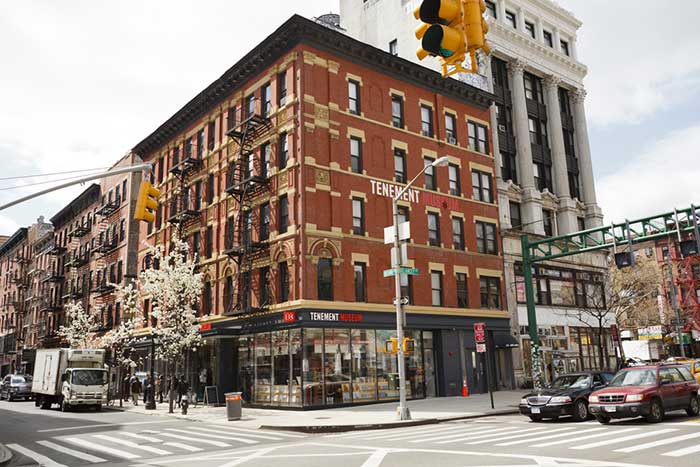
Today, there is controversy around the topic of refugees and migrants. But this museum shows that this has always been the case throughout history. Previous generations were just as concerned about immigration as people are today. Yet America is a successful country built on that very thing. The museum highlights the individual impact of immigration. It focuses on the human stories behind the statistics.
The Tenement Museum is one of many museums dedicated to documenting the migrant experience. Examples can be found all over the world, from Belgium’s Red Star Line Museum to the Canadian Museum of Immigration at Pier 21. These institutions play a key role in discussing the context of the issue. They are keen to demonstrate the bigger picture of migration and show the positive impact of refugees and migrants.
Where to start?
There are plenty of resources for museums wanting to work with refugees. Museums and Migration is a useful website. It is run by Anna Chiara Cimoli, an art historian and museum mediator based in Milan, and Maria Vlachou, a Cultural Management and Communications consultant based in Portugal. The site documents case-studies of museums who have been working to develop projects around this topic. In an interview with the American Alliance of Museums, they give some advice on where to start.
Museums have a positive role to play in the refugee story
Starting a new life in a strange place is tough. This is the case whether people have been forced to leave their homes, or they have chosen to leave for a chance at a better future for their families. Writing in the Guardian, Alexander Betts notes that “People who fall outside the internationally recognised definition of a refugee but are nevertheless fleeing very serious socio-economic rights deprivations might be called ‘survival migrants’.” Just because a person is not fleeing for their life, does not mean that the choice to leave is one made lightly. Migrants often face serious issues in their home countries that mean leaving is their only hope.
Museums can help to welcome refugees and migrants into their new communities. They can give them a voice, and a way to connect. They provide a human, individual angle to a global issue and this can help local people to understand. After all, museums are experts at telling people’s stories throughout history. As the Tenement Museum tells us, America is a nation shaped by generations of immigrants, and its “brightest hope for the future lies in the lessons of the past.”
Multaka-Oxford offers another example of people sharing their knowledge through museum tours and interpretation.
The Migration Museum’s shopping-centre home shows how location, front-of-house work and everyday stories can connect.


About the author – Charlotte Coates
Charlotte Coates is a Brighton based writer working extensively in the arts and cultural spaces. Charlotte has explored a wide range of museum related subjects since she started writing for MuseumNext in early 2019.