Fresh ideas from museums around the globe in your inbox each week

June 11 2026
 By Manuel Charr
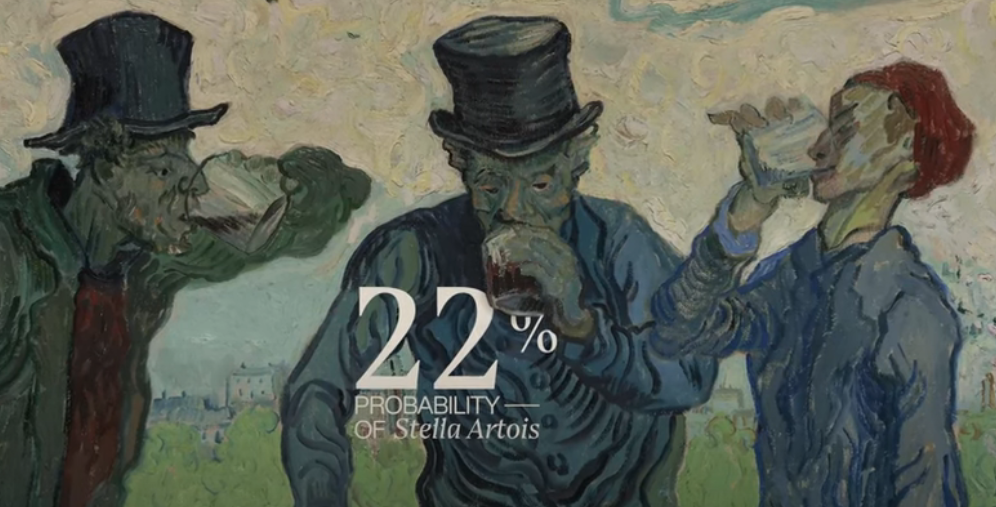
When Argentina’s Museo Nacional de Bellas Artes opened its doors to an algorithm, a beer brand and a question nobody could quite answer, the team reported its most popular interactive experience at the museum to date.
Stand in front of Pieter Brueghel’s The Peasant Wedding and you’ll see revellers, jugs, and tankards of something golden being passed around a crowded table. What you can’t know, what nobody can know, is exactly what they’re drinking. An algorithm built in Buenos Aires for the Stella Artois campaign assigned it a 78% probability of being an Artois. That was the campaign model’s estimate, rather than a historical identification of the drink.
That unlikely statistic is the basis of The Artois Probability, a collaboration between Stella Artois, creative agency GUT Buenos Aires and the Museo Nacional de Bellas Artes. The commissioned campaign used data science to invite visitors to consider an art-historical question hiding in plain sight. The beer’s brewing heritage stretches back to Leuven in 1366, so how likely is it that the drinks in Europe’s great paintings, the Manets and Van Goghs and Brueghels, were actually an Artois?
“I remember getting the phone call and he was just pitching the idea,” says Mariano Gilmore of Amigos del Bellas Artes, the museum’s friends association, recalling the moment the project landed. “It was like, ‘Are you sure we can trace it?’ And he goes, ‘Yeah, through AI you can actually use it, but we have to feed accurate data.'”
How the campaign calculated its probabilities
The premise rests on a quirk of brand history. The Den Hoorn brewery that would become Stella Artois opened in Leuven, Belgium, in 1366, and over the following centuries its beer spread across the same Europe that the old masters were busy painting. Somewhere in those thousands of tavern scenes and wedding feasts, the team reasoned, Artois beer was almost certainly being depicted. The campaign set out to explore that possibility.
Certainty was never on offer, so the team settled for probability. Working with the brand’s historical archive, they built an algorithm that cross-referenced art history with brewery records. More than 3,000 paintings were analysed against a set of variables: the year a work was painted, its geographical location, the colour of the liquid and, most tellingly, the shape of the vessel it was served in. A golden pigment in a Pilsner-style glass suggests one thing; a dark ale in a stoneware jug suggests another. That data was then matched against the brewery’s distribution records for the period, and even the presence of competing breweries in the same region.
“The location was how close the workshop of the artist was to the brewery,” Gilmore explains. In one case, the team discovered an artist had lived just five blocks from the brewery itself. “So it was like, of course he drank one of those.”
Each painting emerged with a percentage expressing the campaign model’s estimated probability that the beer on the canvas was an Artois. Creative Directors Ramiro Rodríguez Gamallo and Matías Lafalla described it as an honest campaign: the brand admitting it can’t be certain, only that it has been around long enough for the question to be worth asking.
The percentage gave visitors a reason to look again at details they might otherwise miss: a vessel, a colour, a place or a date. Its role in the gallery depended on making those clues visible alongside the score. The project therefore brought two kinds of storytelling together: the museum’s paintings and the brand’s account of its brewing history. Reading the result as a campaign’s modelled possibility keeps that invitation to curiosity intact without turning an arresting number into a settled identification.
Taking the experiment into the gallery in 2023
What might have remained a clever print campaign became something more ambitious when the Bellas Artes, Argentina’s most prestigious fine arts museum, agreed to bring it into the galleries. In April 2023, visitors were invited to scan original works in the collection with an augmented reality web app, which overlaid each painting’s Artois Probability score in real time, along with the data behind it.
What the team reported about participation
The public response surprised even the organisers. The team reported that some 24,000 visitors interacted with the app during the exhibition, describing this as a record for the museum. Separately, it reported 7.28 million impressions and 6.7 million unique users for the wider campaign. The project went on to win the Grand Prix in Creative Data at the 2023 Cannes Lions, along with Gold Lions in Print & Publishing and Outdoor, and a Clio Gold in 2024.
For another approach to evaluating what a playful AI experience achieves, the Van Gogh Museum tested both enjoyment and connection to an artwork.
The team, though, is keener to talk about what the numbers represent. “This is not an advertising, it’s a bridge,” Gilmore insists. “A bridge between the world of museums, what we do every day, and the actual living people outside the museums, who are the ones who, in this case, drink beer.”
A new way of seeing the same painting
Juan Szelagowski of Furor Studio directed the project’s film and brought the technical vision. His colleagues describe him affectionately as the resident “freak of AI”, the one who saw, two years before the current wave of AI enthusiasm, that the tools existed to make the idea work. The technology was, by Gilmore’s cheerful admission, “rudimentary” by today’s standards, and much of it had to be built from scratch. To the team, that only adds to the achievement.
“We’re actually the avant-garde movement of this new dawn,” Gilmore says. “It’s something that’s not been done. And it’s only through the connection of different areas that we can actually approach it.”
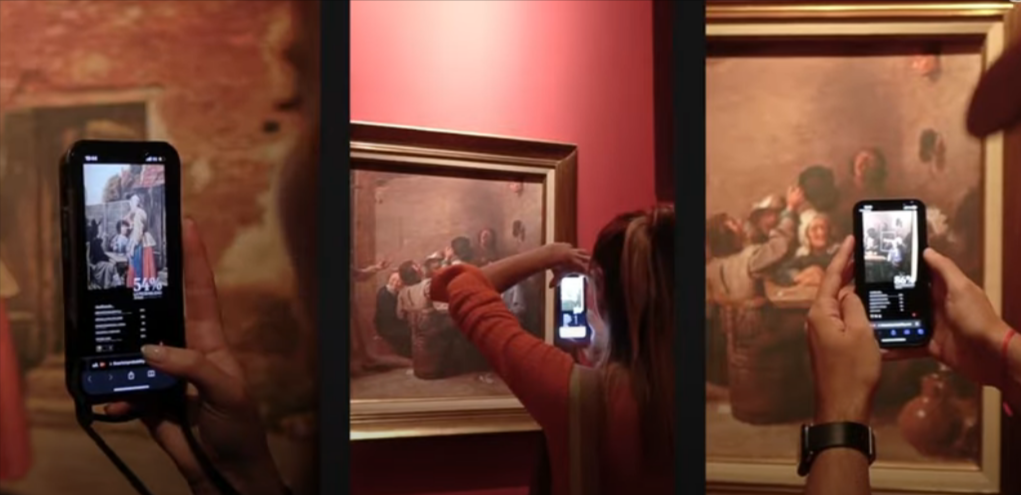
Luz Arriaga, creative content producer with the Friends of the National Museum of Fine Arts Association, sees the project as a case study in what happens when museums stop guarding their collections and start playing with them. A visitor who has scanned a Brueghel and debated a probability score sees the painting differently from the one who walked past it last year. It becomes a document of everyday life, of trade routes and tavern culture and the things ordinary people drank six centuries ago.
“AI is a powerful tool to blur the limits between art, science and ourselves,” Arriaga reflects. “And a powerful tool for museums to build bridges between communities.”
Asked to sum the whole thing up in a single word, Gilmore doesn’t hesitate: probability. “We didn’t know if it was going to work. We didn’t know it was going to win an award. We just had the idea and took it as far as we could, as far as the technology could take it. It’s a probability that we turned into something alive.”
The next time you find yourself in front of a finely painted pub scene, you may struggle not to wonder about the glass on the table. Which, of course, was the idea all along.
–
This article is based on the presentation, “Reinvented heritage storytelling through art, data, and creativity”, by Luz Arriaga (Friends of the National Museum of Fine Arts Association), Mariano Gilmore (Amigos del Bellas Artes) and Juan Szelagowski (Furor Studio) at the Museum AI Summit 2026 organised by MuseumNext. The presentation explored The Artois Probability, a collaboration between Stella Artois, GUT Buenos Aires and the Museo Nacional de Bellas Artes, Buenos Aires.


About the author – Manuel Charr
Manuel Charr is a journalist working in the arts and cultural sectors. With a background in marketing, Manuel is drawn to arts organizations which are prepared to try inventive ways to reach new audiences.


