Fresh ideas from museums around the globe in your inbox each week

This account follows the Ashmolean Museum of Art and Archaeology’s work with Vortic to create a virtual Money Gallery. At the time of the team’s presentation, they were preparing the launch and planning how to evaluate its use. The project aimed to let audiences examine small coins and artefacts beyond the physical display.

The Ashmolean Museum is home to one of the most significant coin collections in the world, with over 300,000 items spanning centuries of history. In its Money Gallery, a carefully curated selection of these objects offers visitors a window into the economic, cultural, and political narratives of past civilisations.
How can museums use technology to enhance the accessibility and engagement of small, intricate objects like coins?
In a recent project, Dr Courtney Nimura and Victoria Jenner from the Ashmolean have collaborated with Vortic, a company specialising in virtual reality (VR) and digital exhibitions, to create an innovative solution.
By harnessing the power of VR, the team developed a digital version of a temporary display of Iron Age coins and artefacts, intended to support exploration beyond the physical exhibition.

Bringing the Iron Age to Life
The project centres on a striking temporary exhibition from the Money Gallery, which focused on coins and material culture from England’s pre-Roman Iron Age.
Curated by Dr Courtney Nimura, the display explored the visual world of the Iceni, an Iron Age community inhabiting present-day East Anglia. This display celebrated some of Britain’s earliest coins during a period of immense social and political transformation.
Coins, often studied in isolation, were presented alongside other contemporary artefacts to highlight their role within the wider visual culture of the Iron Age.
Visitors were invited to make connections between the imagery and ornamentation of these coins and other objects from the same period.
Capturing the detail of small, reflective coins
For many museum-goers, coins can be challenging to appreciate due to their size. In a physical gallery, they are often displayed behind glass, limiting how closely visitors can inspect them.
Virtual reality exhibitions offered a solution to this issue, enabling audiences to explore the coins and artefacts in stunning detail from anywhere in the world.
The collaboration with Vortic involved capturing 3D models of the objects using advanced photogrammetry, a process that combines multiple high-resolution photographs to generate accurate and detailed 3D digital replicas.
However, this was no small feat, particularly when working with coins. Their small size and reflective, metallic surfaces created unique challenges for scanning, as light reflections often interfere with image capture.
The team tackled this by carefully controlling lighting conditions and applying photogrammetry techniques that allowed them to balance detail and accuracy.
This meticulous process ensured the resulting digital models were true to the originals, enabling viewers to inspect even the tiniest engravings and textures with unprecedented clarity.
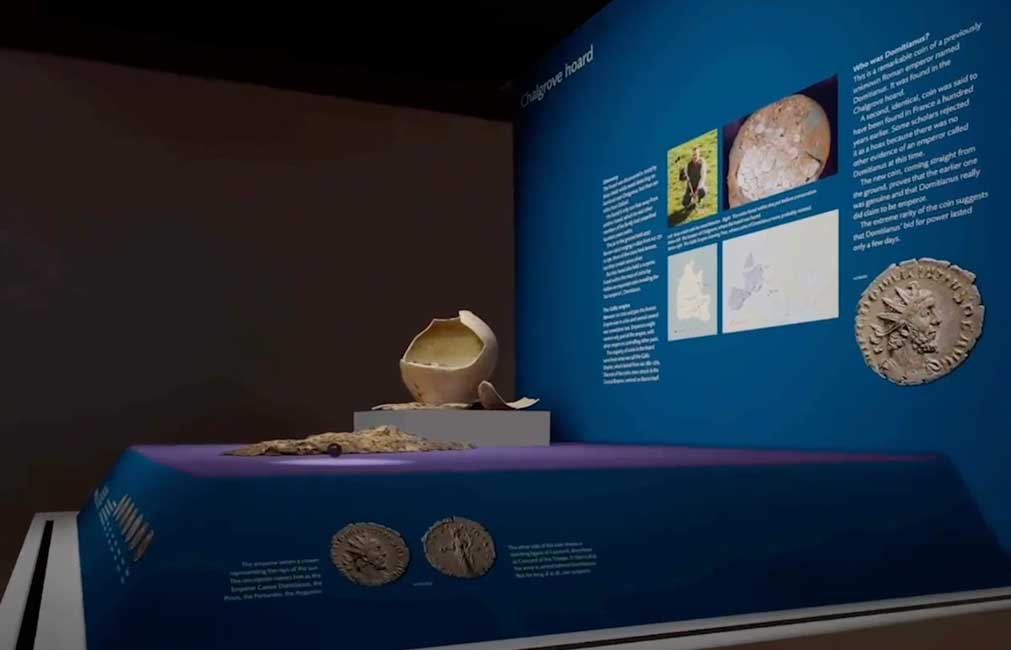
A New Way to Experience the Money Gallery Through Virtual Reality Exhibitions
The resulting virtual reality exhibition replicates the Ashmolean’s physical Money Gallery while enhancing it with new opportunities for engagement.
Visitors can “walk” through the virtual exhibition, interact with the artefacts, and listen to accompanying audio guides that provide further context.
This immersive approach offers a unique perspective, giving audiences a more intimate experience with objects that might otherwise be overlooked.
In addition to preserving the temporary Iron Age display, the VR gallery incorporates elements of the permanent Money Gallery collection.
Highlights include the Anglo-Saxon Crondall Hoard, considered the birthplace of English coinage, and the Oxford Crown, minted in 1644 during the English Civil War.
These objects, rich in detail and history, come to life in the virtual space, offering global audiences an experience that transcends the limitations of physical exhibitions.
Reusing a virtual gallery after a temporary display
Temporary exhibitions are an integral part of museum programming, but they often require significant resources, from curatorial expertise and conservation efforts to installation costs and marketing campaigns.
These projects also pose logistical challenges, such as securing loans, managing time-sensitive displays, and balancing the demands of permanent collections.
Despite the substantial investment, temporary exhibitions are inherently transient, existing for a limited time before being dismantled and archived.
This can leave institutions grappling with how to extend their value and reach beyond the physical gallery space.
The Ashmolean’s partnership with Vortic presents a solution to this challenge by turning temporary displays into evergreen digital experiences that can be enjoyed long after the physical exhibition has closed.
This approach aligns with the Ashmolean’s mission to preserve, share, and celebrate its collections for future generations.
The team intended the virtual gallery to broaden access to the Money Gallery and help audiences examine small, intricate objects such as coins.
Planning launch and audience evaluation
Reflecting on the development of the project, Dr Courtney Nimura and Victoria Jenner see great potential for future collaborations and VR exhibitions.
The initial investment in creating the virtual Money Gallery has established a foundation for curating additional displays independently, showcasing more of the Ashmolean’s extensive collection to audiences around the world.
Dr Courtney Nimura and Victoria Jenner’s Museum XR Summit account describes a virtual gallery built to give small objects more room for examination. For the Ashmolean and Vortic, that meant tackling the photography of reflective coins as well as arranging the wider display. The resulting gallery offered a base for future exhibitions, extending the value of the initial build. At the time described here, launch promotion and evaluation were still being planned. Virtual visits, time spent in the exhibition and audience feedback were the proposed measures for understanding how people would use it.
Compare this reusable gallery with recreating collection spaces in VR, or begin at a smaller scale with prototyping with archive material at Kew.
At the time of the presentation, the virtual reality exhibition was scheduled to launch in July during the Festival of Archaeology, offering audiences the chance to explore this remarkable display online.
The Ashmolean team planned to promote the launch through a combination of targeted social media campaigns, email newsletters, and partnerships with cultural organisations to maximise its reach.
The team planned to measure success through audience engagement metrics, including virtual visits, dwell time within the exhibition, and feedback collected post-launch.
For those eager to experience the treasures of the Ashmolean’s Money Gallery now, further information is available on the museum’s website, where the Heberden Coin Room’s fascinating history and collections are showcased.
The project aimed to extend the reach of these coins and artefacts beyond the original display.
–
Dr Courtney Nimura and Victoria Jenner from Ashmolean Museum shared their work at the Museum XR Summit 2023.